Menopause: More Than a Milestone
Menopause is often framed as a moment—an age, a date, a diagnosis. But in reality, it’s a transition. One that unfolds gradually and touches far more than cycles and hormones.
As estrogen levels decline, the body begins to shift in subtle and not-so-subtle ways. Energy, sleep, mood, and yes, skin start to tell the story. And while this chapter is completely natural, it’s also one where many women begin to notice changes that feel unfamiliar.
Skin, in particular, becomes a mirror of what’s happening within.
5 Never Miss An Article – Get on the VIP Email List
When Your Skin Starts to Feel Different
If your skin suddenly feels drier, thinner, or less “bouncy” than it used to, you’re not imagining it.
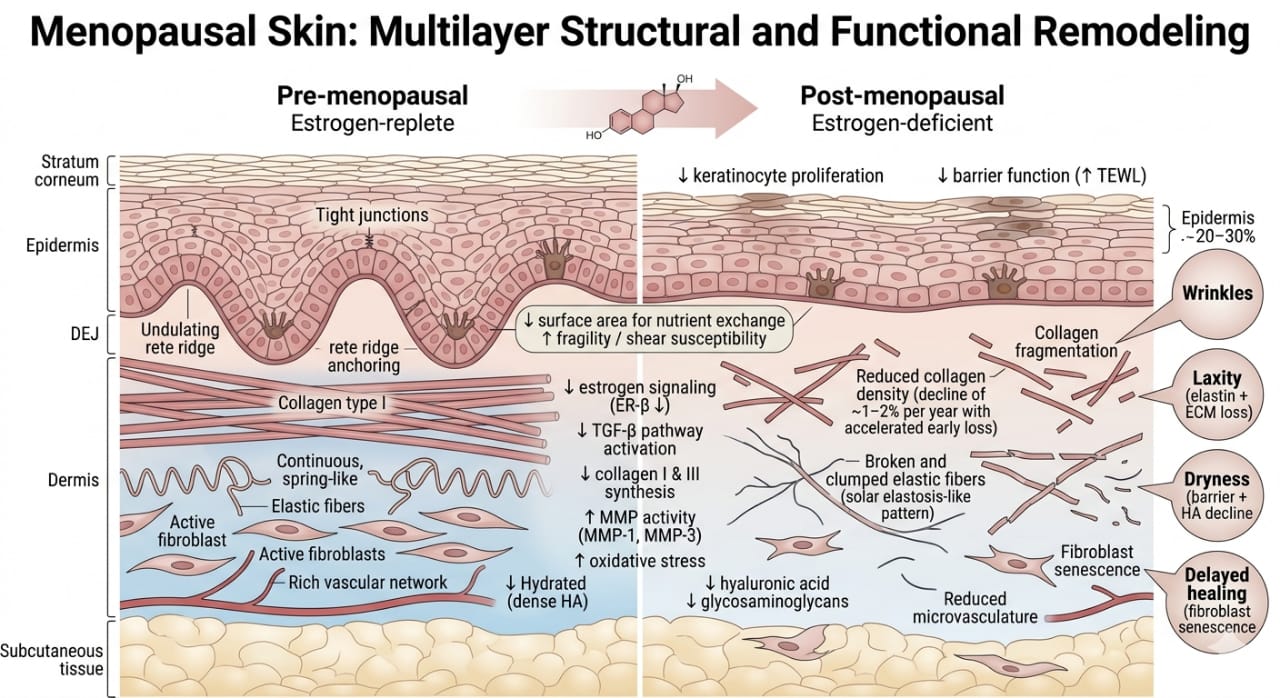
During menopause, the drop in estrogen has a direct impact on how skin behaves. Collagen, the protein that gives skin its structure, declines rapidly. In fact, studies suggest that up to 30% can be lost in the first few years after menopause. At the same time, natural hydration levels decrease, and the skin’s ability to repair itself slows down.
What does that look like in real life?
- Fine lines that seem to deepen faster
- A feeling of dryness that your usual moisturizer can’t quite fix
- Skin that appears thinner or more fragile
- A loss of firmness around the jawline, cheeks, or neck
- Tone and texture become less even
Dermatology research has consistently shown that estrogen plays a central role in maintaining skin thickness, elasticity, and hydration. When it declines, the skin’s support system quite literally changes.

Contribution by Dr. Alberto Leguina
Dr. Alberto Leguina-Ruzzi is a Biologist, Doctor of Medical Sciences, Physician, and Dermatology Specialist with more than a decade of experience across biomedical research, university teaching, clinical practice, and the pharmaceutical industry.
He currently serves as President of the Chilean Chapter of ISWAM (International Seminar and Workshop in Aesthetic Medicine) and has shared his expertise on stages around the globe—including IMCAS, MEIDAN, SOCHIMCE, AIDA, and 5-CC, among other major international congresses.
Throughout his career, Dr. Alberto has led continuing medical education initiatives, offered scientific and technical support to sales teams, and ensured the ethical, accurate, and clinically relevant communication of medical and pharmaceutical innovations.
The Beauty Insider You Didn’t Know About: Stem Cell Conditioned Media
If you’ve been paying attention to advanced skincare, you may have come across the phrase stem cells. But what’s actually making waves right now isn’t the cells themselves; it’s what they produce.
Stem cell conditioned media is, quite simply, a concentrated blend of skin-repairing signals, growth factors, peptides, and tiny messengers that stem cells release naturally. These signals are what help orchestrate repair and regeneration in the body.
Think of it less as adding something foreign to your skin, and more as giving your skin instructions it may have forgotten over time.
Why is this exciting? Because these signals can:
- Encourage collagen production
- Support skin repair
- Improve texture and elasticity
- Help calm inflammation
- Boost overall skin vitality
Early clinical studies in dermatology have shown improvements in wrinkles, hydration, and skin quality when these bioactive ingredients are applied topically or used in procedures.
From Lab to Luxury: How It’s Used Today
What once lived only in research labs is now finding its way into both high-performance skincare and in-clinic treatments.
At home, you’ll find stem cell-conditioned media in serums designed to elevate your routine, often paired with ingredients like hyaluronic acid or antioxidants for a multitasking effect.
In aesthetic clinics, the approach becomes more targeted:
- Microneedling + conditioned media: tiny channels in the skin help these regenerative signals penetrate deeper
- Mesotherapy: microinjections deliver them directly where they’re needed
- Post-laser or radiofrequency treatments: used to support healing and enhance results
The appeal? Not just better results, but often healthier-looking skin with less downtime.
Why Menopausal Skin Loves It
Menopausal skin isn’t just aging; it’s losing communication.
The signals that once told your skin to produce collagen, stay hydrated, and repair efficiently become quieter over time. Stem cell-conditioned media works by reintroducing those signals.
It doesn’t replace hormones. It doesn’t “reverse time.” But it may help your skin function more like it used to.
For many women, that translates into skin that feels:
- More resilient
- Better hydrated
- Smoother in texture
- Subtly firmer and more luminous
It’s less about transformation and more about restoration.

The Conversation We Still Need to Have
As promising as this space is, it’s not without its grey areas.
Not all products are created equal, and the term “stem cell” can sometimes be more marketing than medicine. The source of the conditioned media, how it’s processed, and how much is actually active all matter, and these details aren’t always transparent.
There’s also ongoing discussion in the scientific world about how best to standardize these treatments and what role newer technologies, like exosomes, will play.
In other words, this is an exciting frontier, but still a developing one.
The Takeaway: A New Way to Think About Menopausal Skin
Menopause isn’t the end of good skin; it’s the beginning of different skin. And understanding that shift is where real empowerment begins.
Stem cell conditioned media offers a fresh perspective. Instead of simply adding moisture or masking changes, it works at a deeper level, supporting the skin’s own ability to regenerate and adapt.
And maybe that’s the real beauty of it. Not chasing the past. But helping your skin move forward stronger, healthier, and very much alive.