For years, corrective skincare had a fairly straightforward playbook. See pigment? Brighten it. See rough texture? Resurface it. See dullness? Exfoliate it.
But skin, inconveniently, did not get the memo that it was supposed to be simple.
Visible discoloration, uneven texture, and compromised skin quality can involve multiple interconnected biological processes, including melanogenesis, inflammation, oxidative stress, impaired cellular turnover, barrier dysfunction, and changes within the extracellular matrix.
That is why advanced skin correction is increasingly becoming less about chasing one visible symptom and more about asking what biological processes are contributing to it.
It is also what makes M.A.D Skincare’s new CARBONETIX Brightening + Resurfacing Facial interesting from an educational perspective. The protocol takes a multi-pathway approach, combining controlled resurfacing, pigment regulation, calming support, antioxidant defense, cellular support, hydration, barrier recovery, and photoprotection.
In other words, the peel is part of the plan. It is not the entire plan.
Advanced Skin Correction Is Moving From Symptoms to Biology
The philosophy behind M.A.D Skincare’s protocol mirrors a larger conversation taking place within medical aesthetics.
In his recent L+A article on skin aging and the evolution from resurfacing toward regeneration, plastic surgeon Abdulrahman Abdulbaky, MD, MRCS, described a significant change in how aesthetic medicine is approaching skin rejuvenation.
“Today, our goal is no longer simply to remove damaged tissue or replace what has been lost. Increasingly, we are seeking to restore the biological function of aging skin itself.”
That is a powerful distinction.
For skincare professionals, it means evaluating more than what needs to be removed, exfoliated, or inhibited. What needs to be calmed? What needs protection? What is creating oxidative stress? How is the barrier functioning? What environment are we creating for cellular repair?
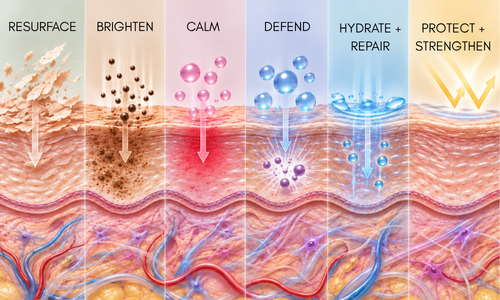
M.A.D’s CARBONETIX Brightening + Resurfacing Facial organizes those questions into six pathways: resurface, brighten, calm, defend, hydrate and repair, then protect and strengthen.
The Multi-Pathway Approach to Advanced Skin Correction
A client presenting with hyperpigmentation may have excess pigment at the surface, but simply exfoliating those pigmented corneocytes does not necessarily address why discoloration developed or what could contribute to its recurrence.
The CARBONETIX Brightening + Resurfacing protocol approaches correction from several directions at once.
Controlled exfoliation addresses accumulated surface cells and turnover. Brightening technologies target pathways associated with excess melanin. Calming ingredients help manage inflammation. Antioxidant strategies address oxidative stress. The CARBONETIX Skin Rejuvenating System introduces another layer focused on the cellular environment, while hydration, barrier support, and SPF help protect the skin during and after correction.
Think less skincare whack-a-mole. Think coordinated treatment strategy.
1. Resurface, But Know Why You Are Resurfacing
The treatment begins its corrective work with two complementary forms of exfoliation.
The Four Fruit Enzyme Exfoliating Mask w/Pumice combines pineapple, papaya, blueberry, and cherry with physical exfoliation. Enzymatic activity helps loosen accumulated surface cells while fine pumice provides controlled polishing.
The Delicate Skin Resurfacing Peel then incorporates naturally occurring AHAs derived from bilberry, sugarcane, and citrus to support controlled exfoliation and epidermal renewal.
But the important concept for professionals is not simply that the protocol exfoliates. It is where exfoliation sits within the larger strategy.
Dr. Abdulbaky notes that modern rejuvenation increasingly considers fibroblast activity, extracellular matrix remodeling, vascular health, inflammatory pathways, and cellular communication. He also argues that combination therapy can address different components of tissue aging more comprehensively than a single modality.
That puts resurfacing in its proper place within advanced skin correction. It is an important tool, not the whole toolbox.
2. Target Pigment Through Multiple Pathways
Following resurfacing, the protocol turns toward pigment regulation.
M.A.D incorporates brightening ingredients across multiple steps, including emblica, bearberry and mulberry extracts, 4-Butylresorcinol, β-White™, Lumiskin™, vitamin C technologies, and other pigment-focused ingredients.
Rather than handing one ingredient the keys and wishing it luck, the strategy distributes corrective activity across the treatment.
This matters because hyperpigmentation itself is not necessarily a single-pathway problem. Pigment production can intersect with inflammation, UV exposure, oxidative stress, and the skin’s response to injury.
3. Calm the Skin Because More Inflammation Is Not More Correction
Here is where advanced correction requires some restraint.
After resurfacing, the Delicate Skin Calming Gel Mask w/Delicate Skin Booster Serum incorporates soothing and hydrating ingredients to help reduce visible irritation and support recovery.
This is particularly relevant when treating pigment-prone skin.
Dermatologist Shino Bay Aguilera, DO, FAAD, made the point beautifully in his L+A discussion of cell-centered aesthetic medicine and the extracellular matrix:
“A stronger injury does not automatically produce a better outcome.”
He specifically notes that treatment planning should identify the biological response being sought and the amount of injury actually required to achieve it.
For professionals, that may be one of the most important lessons in advanced skin correction. Activity needs a purpose. More aggressive does not automatically mean more advanced.
4. Cellular Bioactivity Changes the Correction Conversation
The CARBONETIX Skin Rejuvenating System is where M.A.D’s approach expands beyond exfoliation and pigment-focused ingredients.
CARBONETIX uses chemical reactions to release CO₂ and molecular hydrogen, H₂. M.A.D describes the system as increasing oxygen-rich blood flow while molecular hydrogen interacts with damaging reactive species associated with oxidative stress. The brand positions this process around circulation, cellular activity, and creating an environment supportive of healthy skin function.
That cellular focus becomes especially interesting when viewed alongside Dr. Aguilera’s discussion of the extracellular matrix.
“The tissue we treat can shape the response we get,” he writes.
He explains that fibroblasts do not operate independently. Their behavior is influenced by their surrounding matrix, mechanical signaling, inflammation, hydration, and access to resources involved in tissue maintenance. His larger question for aesthetic professionals is therefore not simply what treatment should be performed, but what environment we are asking cells to function within.
M.A.D’s CARBONETIX technology and Dr. Aguilera’s work are not the same intervention, and they should not be presented as equivalent clinical evidence. What is notable is the philosophical overlap: modern aesthetic treatment planning is paying considerably more attention to the biological environment surrounding cellular activity.
That is a much bigger conversation than “How strong is the peel?”

5. Recovery Is Part of Correction
Following corrective activity, M.A.D incorporates niacinamide, sodium hyaluronate, Pro-Vitamin B5, magnesium glycinate, and magnesium oxide to support hydration, barrier function, and post-resurfacing recovery.
This is not the boring part after all the exciting corrective ingredients have left the building.
Recovery is part of the treatment.
Dr. Aguilera similarly argues that professionals considering biostimulation and bioregeneration should also think about hydration, barrier integrity, inflammatory burden, and the patient’s capacity for repair.
That philosophy has significant implications for treatment planning. The question is not only how much activity the skin can tolerate during an appointment. It is whether the complete protocol creates appropriate conditions for recovery afterward.
6. Protection Is an Active Part of Advanced Skin Correction
Finally, the CARBONETIX Brightening + Resurfacing Facial ends with broad-spectrum sun protection.
That may sound like Skincare 101, but in a pigmentation-focused treatment, SPF is not the ceremonial final step before the client heads to checkout.
UV exposure can contribute to oxidative stress, inflammation and melanogenic signaling. Dr. Aguilera goes so far as to call protection “a treatment decision,” pointing to clinical evidence demonstrating that daily sunscreen use can reduce the progression of photoaging.
M.A.D therefore finishes its multi-pathway strategy by protecting the environment it just spent an entire facial trying to improve.
For professionals who want a deeper look at how these six phases come together, L+A previously broke down the complete M.A.D CARBONETIX Brightening + Resurfacing Facial, including the products, ingredients, and professional protocol.
Advanced Correction Means Asking Better Questions
Perhaps the most interesting thing about the CARBONETIX Brightening + Resurfacing Facial is not any individual ingredient, peel, or step.
It is the treatment philosophy.
Resurface. Regulate pigment. Calm inflammation. Address oxidative stress. Support cellular function. Restore hydration. Protect the skin.
That is a very different conversation from simply asking which peel will make a client look brighter by Friday.
Both Dr. Abdulbaky and Dr. Aguilera are pushing aesthetic medicine toward a more biologically informed way of thinking about skin. One asks clinicians to move beyond simply removing damaged tissue. The other asks professionals to consider the environment in which cells are being asked to function.
M.A.D Skincare’s multi-pathway approach to advanced skin correction fits squarely within that evolving philosophy.
For medical and spa aesthetic professionals, that may be the real takeaway. Better correction does not necessarily mean doing more to the skin. It means understanding more about the skin, then making sure every step in the treatment has a very good reason for being there.