PRP Gel vs PRF Gel
Among regenerative aesthetic treatments, few topics generate more debate than platelet-rich plasma (PRP) and platelet-rich fibrin (PRF). Over the past several years, many clinicians have gravitated toward PRF-based systems based on the belief that they offer superior regenerative potential through a more natural preparation process and prolonged growth factor release. More recently, newer PRP gel technologies have entered the market, challenging some of these assumptions and prompting an important question:
Does the available science actually support PRF as clinically superior, or are the differences primarily theoretical?
As regenerative medicine continues to evolve within aesthetics, understanding the distinctions between liquid PRP, liquid PRF, PRP gel, and PRF gel is critical for evidence-based decision-making.

Dr. Krystal Briglia, L+A Medical + Wellness Contributor
Dr. Krystal Briglia of Triada Integrative Medicine + Wellness is a board-certified nurse practitioner specializing in aesthetic dermatology, integrative medicine, and wellness. She has an extensive and diverse background in healthcare, with over a decade of experience working in emergency, critical care, trauma, aesthetics, healthcare administration, and healthcare education. Krystal holds multiple board certifications, including family practice, emergency, and critical care. Her educational background includes two undergraduate degrees, a degree in health sciences, and a bachelor’s degree in nursing from the University of Delaware. She holds three graduate-level degrees, including a master’s degree in nursing leadership, a master’s degree in business administration, and completed her nurse practitioner education at the University of Massachusetts. In 2016, Krystal completed her clinical doctorate in nursing practice. Dr. Briglia is an entrepreneur and specializes in organizational process improvement. She is a Lean Six Sigma master black belt, a certified Six Sigma champion, and a certified Kaizen facilitator. She also has a passion for education and spent 6 years teaching health profession graduate-level courses. During that time, she held a lead faculty position and helped the university develop a family nurse practitioner program from inception to credentialing and first graduates. Read Full Bio
Understanding the Basics
Although PRP and PRF are often discussed interchangeably, they are biologically distinct preparations.
Platelet-rich plasma is typically produced by centrifuging blood in tubes containing an anticoagulant. The anticoagulant prevents clot formation during processing, allowing concentration of platelets within a plasma fraction that can subsequently be injected or converted into a gel matrix.
Platelet-rich fibrin is produced without anticoagulants. Because coagulation begins naturally during processing, a fibrin scaffold develops that entraps platelets, leukocytes, cytokines, and growth factors within a three-dimensional matrix.
This difference in preparation forms the basis for many of the claims surrounding PRF superiority.
Never Miss An Article – Get On The VIP Email List
Liquid PRP vs Liquid PRF
The strongest biologic distinction between PRP and PRF lies in growth factor release kinetics.
Multiple studies have demonstrated that PRP produces a relatively rapid release of growth factors shortly after activation. In contrast, PRF appears to provide a slower and more sustained release over several days due to the presence of the fibrin scaffold (Farshidfar et al., 2025; Diab et al., 2023).
Laboratory investigations have shown that PRF may maintain release of vascular endothelial growth factor (VEGF), platelet-derived growth factor (PDGF), transforming growth factor-beta (TGF-β), and other signaling molecules for longer periods than traditional PRP preparations (Chatterjee et al., 2019; Zwittnig et al., 2022).
From a biologic perspective, this finding is logical. The fibrin matrix functions as a scaffold that gradually releases entrapped growth factors rather than allowing immediate diffusion.
The challenge is that biologic plausibility does not automatically translate into superior clinical outcomes.
What Does the Clinical Evidence Show?
This is where the discussion becomes more nuanced.
A recent systematic review comparing PRP and PRF in aesthetic applications found that PRF demonstrated favorable outcomes in skin texture, wrinkles, and crepiness, while PRP showed stronger evidence for treatment of hyperpigmentation. Both treatments demonstrated favorable safety profiles and high patient satisfaction (Sollitto et al., 2025).
Similarly, several comparative studies have reported modest advantages for PRF in skin rejuvenation outcomes, likely related to prolonged tissue stimulation and matrix support.
However, these advantages have generally been incremental rather than dramatic.
Importantly, no high-quality body of evidence currently demonstrates the overwhelming superiority of PRF over PRP across all aesthetic indications.
In other words, the statement that “PRF is better” is not currently supported by the literature.
A more accurate statement would be:
PRF possesses biologic characteristics that may provide advantages in certain regenerative applications, but clinical superiority remains incompletely established.
PRP Gel vs PRF Gel
The discussion becomes even more complex when comparing gel formulations.
Both PRP gel and PRF gel attempt to create a scaffold capable of providing structural support while delivering regenerative signaling molecules.
Historically, PRF gel has been marketed as a more natural option because it forms without anticoagulants and relies on endogenous fibrin formation. Advocates argue that this creates a longer-lasting biologic matrix capable of supporting tissue remodeling.
However, studies evaluating platelet-rich fibrin matrix products and platelet-rich plasma-derived matrices suggest that both approaches can achieve sustained growth factor release and tissue regeneration. Some investigations have demonstrated comparable growth factor release profiles between fibrin-based matrices and platelet-rich fibrin preparations (Chatterjee et al., 2019).
This is where marketing narratives often exceed available evidence.
The presence or absence of an anticoagulant may influence biologic behavior, but current literature does not conclusively prove that a PRF gel will consistently outperform a well-prepared PRP gel in aesthetic outcomes.
Patient Selection May Matter More Than Product Selection
One of the most overlooked aspects of regenerative medicine is patient variability.
A patient with robust platelet counts, healthy vascular function, and minimal systemic inflammation may respond favorably to either PRP or PRF.
Conversely, patients with advanced photoaging, poor tissue quality, smoking history, metabolic dysfunction, or chronic inflammation may respond differently regardless of the platelet concentrate selected.
Rather than searching for a universally superior product, clinicians may benefit more from focusing on patient selection, treatment planning, and protocol optimization.
The quality of the blood product, processing technique, injection technique, treatment interval, and patient biology likely influence outcomes as much as the distinction between PRP and PRF itself.
A Practical Clinical Perspective
In my own practice, I have historically utilized EZ Gel PRF technology and have been pleased with the outcomes observed in skin quality and regenerative applications.
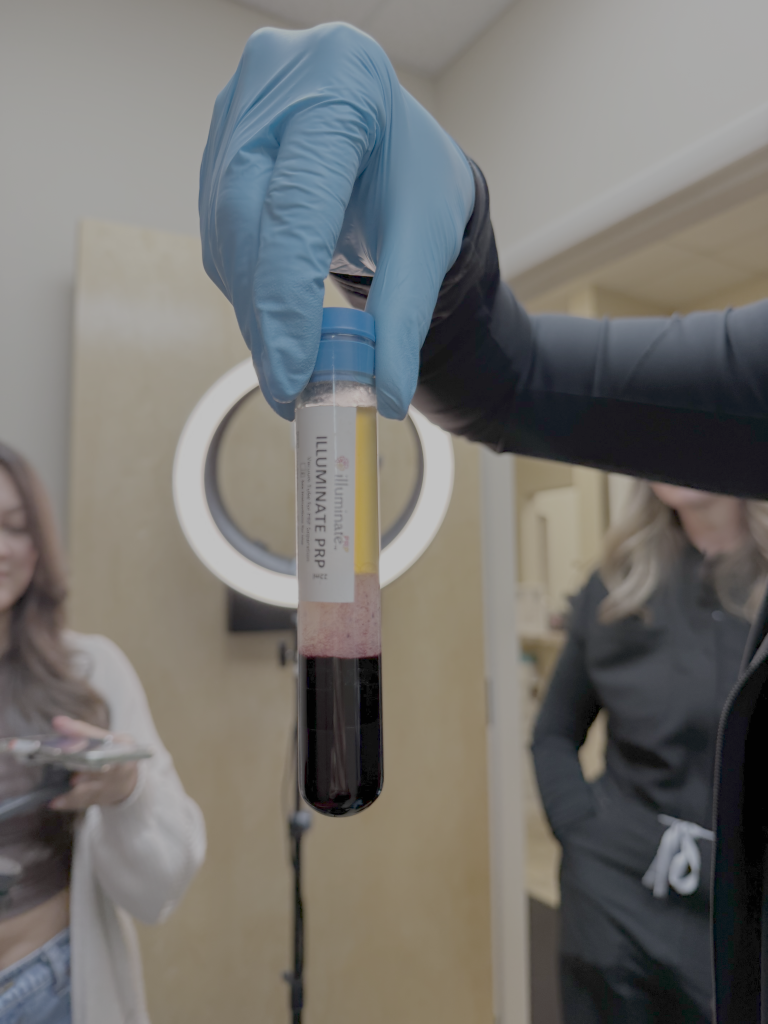
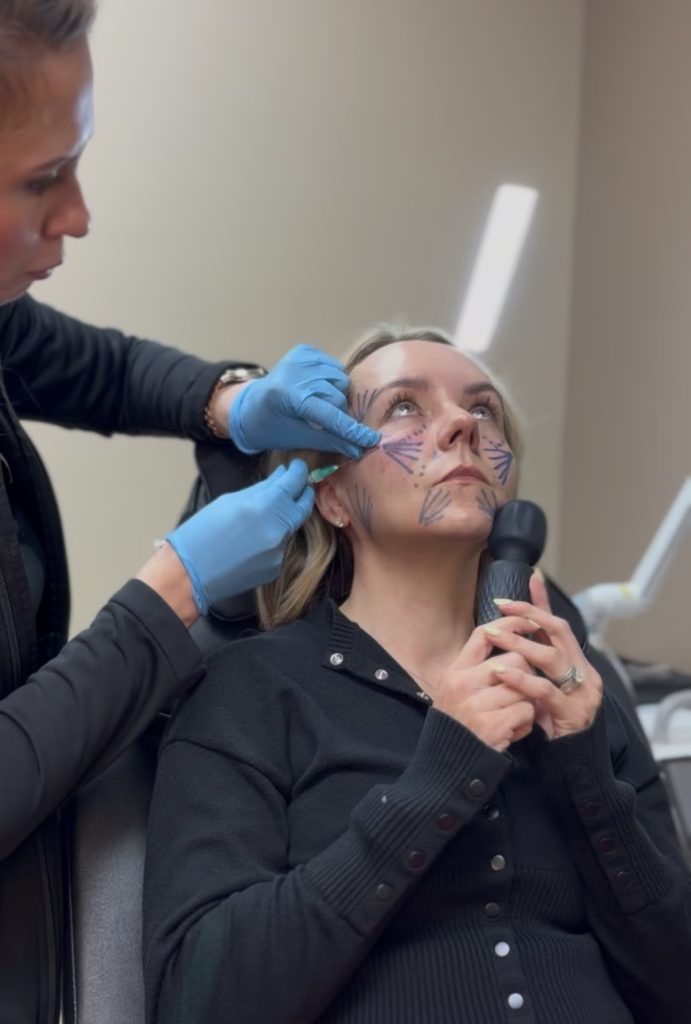
More recently, I began evaluating a PRP gel system, Illuminate, to better understand how these technologies compare in real-world clinical practice. I performed an Illuminate PRP Gel treatment on Jenni Nagle. Her early experience and outcome has been encouraging, but as with any emerging clinical observation, it remains preliminary.
At the time of writing, early patient experiences have been favorable. However, meaningful conclusions require a larger patient sample size, consistent follow-up, and careful observation over time. Anecdotal outcomes, while valuable in clinical practice, should not be confused with controlled evidence.
As a science enthusiast and clinician committed to pursuing the best possible outcomes for patients, I intend to continue investigating these differences in my own practice. As I gather more information, observe longer-term results, and treat a broader patient population, I plan to report future findings with the same evidence-aware lens.
As clinicians, we must remain willing to challenge assumptions, even those we have previously accepted. The regenerative aesthetics space continues to evolve rapidly, and today’s prevailing narrative may look different as comparative studies become more robust.
Conclusion
The current literature supports meaningful biologic differences between PRP and PRF. PRF appears to provide a fibrin scaffold capable of prolonged growth factor release, while PRP delivers a more immediate release profile.
What remains less certain is whether those biologic differences consistently translate into superior aesthetic outcomes.
For now, the evidence suggests that both PRP and PRF are effective regenerative tools with favorable safety profiles. PRF may offer theoretical and biologic advantages in tissue remodeling applications, but claims of universal superiority are not strongly supported by current clinical data.
As regenerative medicine advances, the most important question may not be whether PRP or PRF is better.
It may be which treatment is best suited for the patient sitting in front of us.
Contributor’s Note
One of the challenges in regenerative aesthetics is that biologic rationale often advances faster than clinical evidence. PRF may ultimately prove superior for certain indications, or future studies may demonstrate that specific PRP gel systems perform similarly under select conditions. At present, the literature supports meaningful biologic differences between these technologies, but it does not conclusively establish one as universally superior. For clinicians committed to evidence-based practice, the most responsible approach is continued investigation, thoughtful patient selection, and an openness to evolving data as the field matures.
Explore L+A’s Medical Aesthetic Report