
PDRN Compounds Explained
Polynucleotides (PN) and polydeoxyribonucleotides (PDRN) have emerged as innovative bioactive compounds in aesthetic medicine, primarily used as injectable skin revitalizers to promote regeneration, hydration, and elasticity. These naturally derived DNA fragments, obtained mainly from salmon or trout sperm, act by stimulating cellular repair and increasing fibroblast activity, leading to enhanced collagen synthesis and tissue rejuvenation.

November 2025 L+A Report
Devices That Drive Long-Term Results
We’re diving deeper into the role of device technology within those treatment plans. Because while home care keeps the daily rhythm going, devices are the accelerators—the catalysts that make visible, measurable progress possible.
Across the medical + spa skincare industry, professionals are blending advanced modalities like microneedling, lasers for hair removal, microcurrent, LED, and microchanneling into long-term strategies that are both corrective and preventive. These technologies are not meant for quick fixes; they’re the foundation of consistency—the cornerstone of skin fitness.
Among the two, PDRN is considered superior due to its defined molecular structure, optimal chain length (300 ~1000 nm), and strong affinity for adenosine A2A receptors, which play a key role in modulating inflammation and promoting angiogenesis. This results in more consistent regenerative outcomes, faster tissue healing, and improved dermal quality compared to general PN formulations that may vary in composition and bioactivity.
Limitation of Existing PDRN in Skincare
However, the molecular weight of these polymers is a critical parameter that influences their biological performance and penetration. High-molecular-weight formulations provide deeper hydration and structural support but have limited diffusion, while low-molecular-weight variants penetrate more efficiently but with reduced longevity. Achieving the ideal balance remains an ongoing challenge in formulation design.
Beyond injectables, PDRN has gained attention in topical cosmetic applications such as creams, serums, and masks, where it contributes to skin repair and barrier restoration. Although topical delivery faces bioavailability limitations compared to injections, advances in encapsulation and transdermal systems are improving efficacy. One of the highest limitations of the current products is the molecule size, which makes it almost impossible to penetrate the skin.
Innovation in PDRN by Dr Bum-Ho Bin PhD of prof[b] Bioplasma™, the next-generation topical technology from South Korea
This motivated Dr Bum-Ho Bin PhD, associate professor of Ajou University, leader of the Anti-Aging Research Lab, and Member of the Planning and Evaluation Committee for Skin-Based Technology Development Project, Ministry of Health and Welfare of South Korea, to work for over 20 years in a new technology that would allow the penetration of PDRN in the skin without the need for needles.
3 Main Pillars of All-New PDRN Technology
8 consecutive years of Outstanding Research Excellence Award and more than 70 peer-reviewed papers in leading scientific journals gave birth to the Bioplasma™ prof[b]’s signature technology.
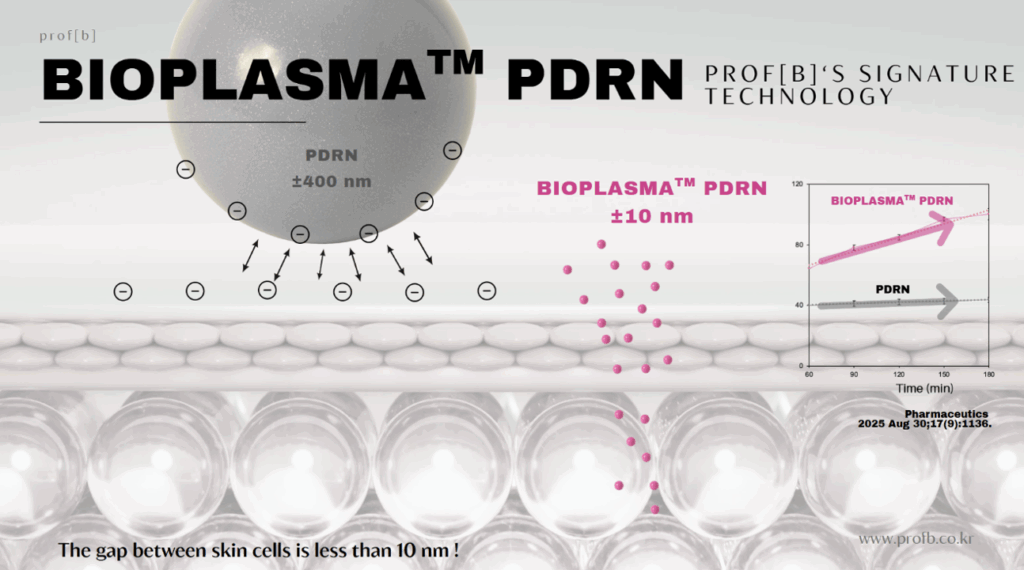
Neutralization
Alters surface charge to effectively pass through the skin barrier.
Nanolization
Nano-sized biomolecules for deep skin penetration.
Bioavailability Boost
Superior skin delivery for fast and powerful effects
prof[b] Next Generation Form of PDRN
This South Korean research group engineered PDRN into a next-generation form that penetrates like an injection without the needle, cost, or discomfort (3rd Gen Injection-like PDRN Cosmetics), which improves skin condition. This highly innovative technology has been implemented in a comprehensive product line named prof[b].
These soon-to-be-released cosmetics are separated into 4 products: Repair Cream, Whitening Booster Serum, Waterful Tone-up Suncream, and Whitening Bubble Face Wash.
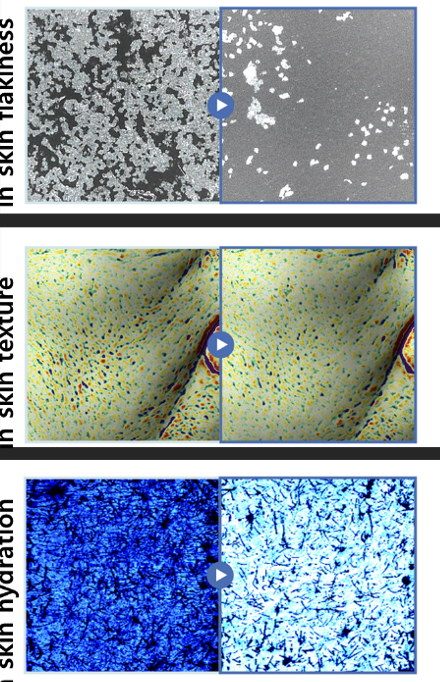
Their clinical studies have shown pore size reduction, increased hydration, reduction of fine wrinkles, improvement of texture, enhancement of glow through exfoliation, brightening, and anti-inflammatory effect.

Contribution by Dr. Alberto Leguina
Dr. Alberto Leguina-Ruzzi is a Biologist, Doctor of Medical Sciences, Physician, and Dermatology Specialist with more than a decade of experience across biomedical research, university teaching, clinical practice, and the pharmaceutical industry.
He currently serves as President of the Chilean Chapter of ISWAM (International Seminar and Workshop in Aesthetic Medicine) and has shared his expertise on stages around the globe—including IMCAS, MEIDAN, SOCHIMCE, AIDA, and 5-CC, among other major international congresses.
Throughout his career, Dr. Alberto has led continuing medical education initiatives, offered scientific and technical support to sales teams, and ensured the ethical, accurate, and clinically relevant communication of medical and pharmaceutical innovations.
Dr. Alberto Leguina-Ruzzi’s Interview with Dr. Bum-Ho Bin of prof[b]
I had the chance to talk with Dr Bum-Ho Bin to ask him more about prof[b]:
Q: Thank you so much, doctor, for your time and willingness to share with us about your brand. You have an impressive scientific background. What motivated you to apply your research to a cosmetic line?
A: Thank you. My primary motivation has been the desire to evaluate technologies that are theoretically unsound and to contribute to the development of products that are scientifically well-founded. Technologies or ingredients in the cosmetics industry that lack proper theoretical explanations are continuously being redeveloped through our own in-house research.

Q: Currently, the cosmetic market is moving towards the use of PDRN, what differentiates prof[b] of other products available?
A: Conventional PDRN has a size of over 300 nm (The gaps between skin cells are less than several tens of nanometers) and carries a negative charge identical to that of the skin, making it unable to be absorbed. We have developed a Bioplasma technology that reduces its size to 10 nm, neutralizes its charge by removing phosphate groups that are associated with aging.
Q: When is the launch expected, and do you think it is going to be available in America in the future?
A: First, the cream is scheduled to launch in Korea this December. We are preparing our website and working to make our products available for purchase in America next year!
Q: How do you envision your products’ line growth, and what are your future plans?
A: The serum, sunscreen, and toner will be released sequentially. In addition to skincare performance, clinical efficacy in improving hair condition has also been confirmed, and we are currently developing hair care products as well.
We plan to continuously conduct theoretical evaluations of products entering the market and use these insights to redevelop the underlying technologies. At the same time, we aim to rapidly commercialize newly developed technologies.
Ultimately, I hope to offer people who’ve never used cosmetics the fun of trying them—at least once.”
Soon I’m going to be traveling to Asia, including South Korea, and I can’t wait to test these promising products and being able to share my personal experience.