Louis Chabert: A Global Perspective on the Future of Professional Skincare
Spend enough time in the professional skincare industry, and you start to realize something: what feels revolutionary in one market might be completely ordinary somewhere else.
A laser treatment commanding hundreds of dollars in the United States might be bundled into an injectable package in China. An esthetician can legally perform microneedling in one European country and cross a border to find that same procedure restricted to physicians. A technology enjoying its comeback in North America may never have disappeared elsewhere.
Perspective, it turns out, depends heavily on where you have been.
And Louis Chabert has been just about everywhere.
Over close to 25 years in prestige beauty and professional skincare, Chabert has worked across Europe, Asia Pacific and North America, holding marketing, innovation and executive roles within some of the world’s largest cosmetic organizations, including L’Oréal, The Estée Lauder Companies, and Unilever Prestige.
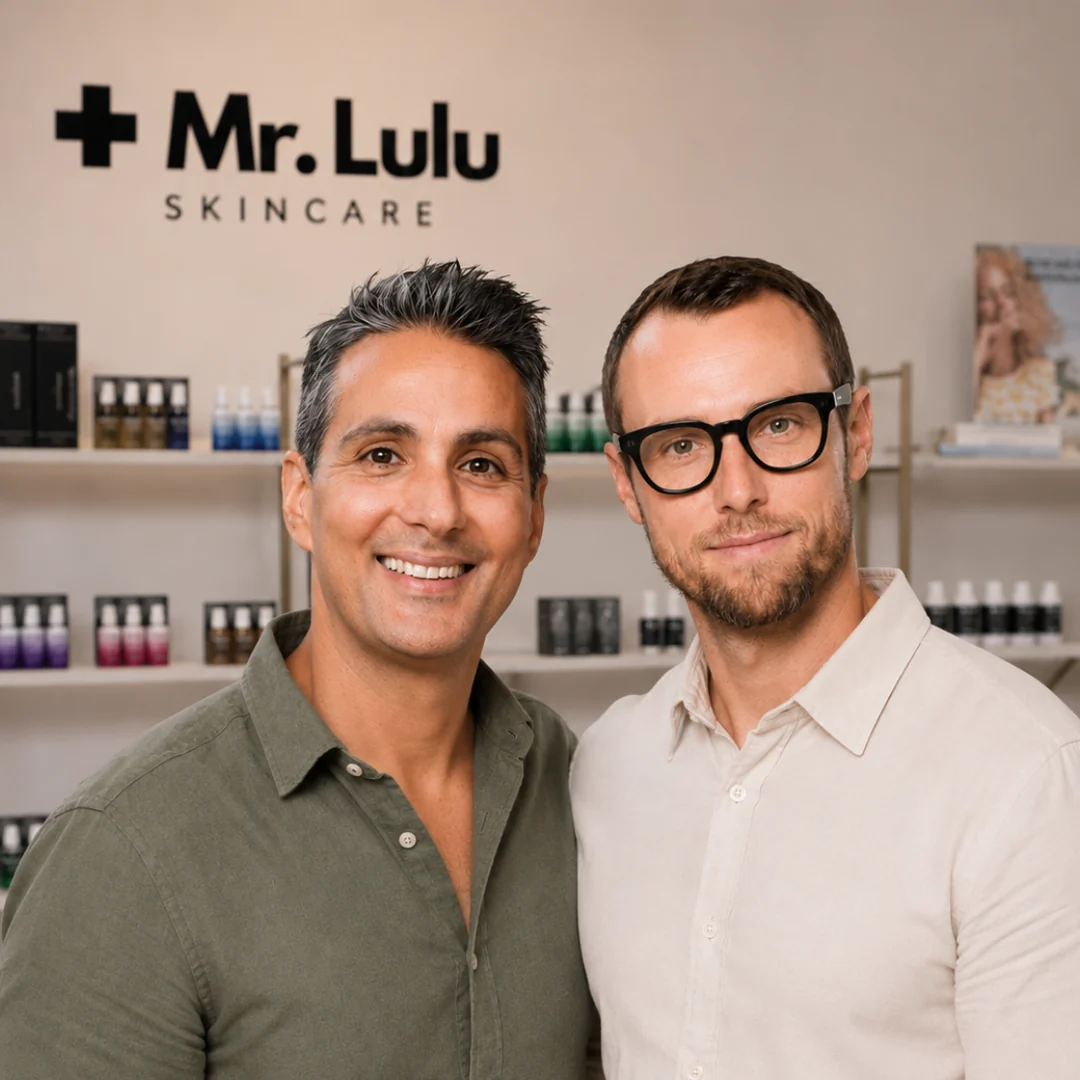
Today, he is the founder of Mr. Lulu Skincare, a professional skincare company specializing in acne and pigmentation and built around an idea that challenges a familiar industry assumption: natural skincare does not have to mean less powerful skincare.
But understanding Mr. Lulu requires understanding Louis Chabert first.
Because the company is not simply the story of an executive who decided to become an entrepreneur. It is the culmination of decades spent observing professional skincare from different countries, corporate offices, laboratories, trade shows, and, perhaps most importantly, treatment rooms.
We sat down with Louis to talk about the experiences that shaped his thinking, what traveling the world taught him about medical + spa aesthetics, how he separates meaningful innovation from industry noise, and why he believes the future belongs to professionals willing to combine expertise, authenticity, and a little courage.
For Louis Chabert, Skincare Started Long Before the Corporate Career
Long before there were international positions and global projects, there was Paris.
And there was Louis’s grandmother.
She was an esthetician and entrepreneur who built her career during the 1970s and 1980s, eventually opening a spa and launching a professional skincare line with a physician.
This was before “medical aesthetics” had become part of the industry’s everyday vocabulary. She formulated products. She treated clients. She built a business.
Louis watched.
“As a kid, I watched what this industry allowed a woman to build for herself in the 70s & 80s, and the way she cared for her clients.”
That early experience gave him something that would remain surprisingly consistent throughout a career spent inside enormous global organizations: a fascination with the individual skincare professional.
Not simply products. Not simply marketing. Not simply beauty.
The treatment room.
“My love for this industry was born long before my career, as a child,” Chabert says. “From a very young age, I had an allegiance to this industry because of her.”
It also explains something about the way he approaches product development today.
“The way I work today, formulating and thinking about the treatment room at the same time, comes straight from her.”
That combination of formulation and practical application would eventually become central to Mr. Lulu. But first, Louis would spend decades developing a much wider view of the industry his grandmother introduced him to.
Never Miss An Article – Get on the VIP Email List
How Global Experience Changed Louis Chabert’s View of Aesthetics
Working with major international cosmetic groups gave Louis access to professional skincare markets around the world.
Travel gave him something arguably more valuable: context.
It is easy to talk about “the aesthetics industry” as though everyone is participating in roughly the same business. Spend enough time internationally, however, and that idea falls apart rather quickly.
“Medical aesthetics can look completely different depending on where you stand,” he says.
Same Skin. Very Different Markets.
Take China.
According to Louis, the country’s highly advanced medical aesthetics market is heavily oriented toward injectables, particularly neurotoxins and biostimulators.
“They see far less value in lasers,” he says. “A clinic there might give you a fractional laser treatment as a gift with purchase when you buy a package of three injectable treatments. Here, that same laser treatment could be $700.”
Same technology. Completely different perceived value.
Then there is scope of practice.
“In Germany an esthetician can microneedle; in France only doctors can,” Louis explains. “That single rule changes the price, the access, and who gets to build a business around something as fundamental as microneedling.”
Even the role of nurses changes significantly by market. Louis points to differences between countries such as the United States and the UK, where nurses occupy significant professional roles within healthcare and aesthetics, and countries such as France and Italy, where their position within the treatment landscape can look considerably different.
Those aren’t minor regulatory details.
They influence who performs treatments, how clients perceive providers, what businesses can be built, and ultimately how an entire aesthetics market develops.
You Can’t Learn Everything From a Market Report
For an executive, data can explain what is happening.
Louis believes being there explains why.
“You can read about all of this in a report,” he says. “But you only really understand it when you’ve sat in the treatment rooms, talked to the practitioners, and seen what they’re allowed to do and what their clients expect.”
“That’s what travel gave me.”
It is also what makes Louis Chabert’s perspective particularly interesting now.
As professional skincare and medical aesthetics increasingly overlap, understanding a single market is no longer necessarily enough to predict where the industry is going.
Sometimes the future is already happening. It is simply happening somewhere else.
How Louis Chabert Separates Innovation From Industry Hype
Of course, seeing innovation around the world creates another problem.
There is a lot to see.
Professional skincare has never exactly suffered from a shortage of new ingredients, technologies, protocols, acronyms or things described as “game-changing.”
Louis has developed a fairly unforgiving filter.
“Does the science hold up, and does it still hold up ten years later?”
Consider the stem cell skincare boom.
Louis remembers the period roughly 15 years ago when stem cells suddenly appeared throughout topical skincare marketing. His skepticism came down to a basic question of whether the biology and delivery actually made sense.
Looking back, he views much of that frenzy as attention rather than a fundamental change in skincare.
Exosomes, however, have his attention.
“The science and the results we’re seeing are far more compelling, and I think we are just at the beginning of what they can do.”
That does not mean Louis believes simply putting “exosomes” on packaging is enough.
Quite the opposite.
He argues that formulation, stability, and application are crucial to whether exosome technology can deliver on its potential. He is particularly interested in professional applications associated with procedures such as microneedling and laser treatments rather than assuming every topical exosome product will perform equally.
In other words, Louis likes innovation.
He just wants receipts.
What Is on Louis Chabert’s Global Aesthetics Watch List?
Walk an international trade show with Louis and three technologies currently have his attention.
The first is iLaser for submental skin laxity, an area where he sees an important gap between traditional non-surgical options and plastic surgery.
The second is the continued development of exosomes.
And the third?
Radiofrequency.
“Radiofrequency is having a revival,” Louis says, pointing to technologies such as Xerf and renewed interest in RF treatments that do not necessarily involve microneedling.
“I think RF on its own, without microneedling, is wonderful and very effective, so I’m excited to see more focus returning to it.”
But devices only tell part of the story.
Louis is equally interested in what is happening with formulation, particularly the challenge of keeping active ingredients potent and stable.
That fascination ultimately helped inspire Mr. Lulu.
“My whole brand started because I kept asking why almost everything on a back bar is built around water and preservatives,” he says.
Which brings us to the entrepreneur chapter.
From Global Executive to Mr. Lulu Skincare Founder
From the outside, leaving the infrastructure and resources of major corporations to launch an independent professional skincare company might look like a dramatic pivot.
Louis doesn’t see it that way.
Entrepreneurship had been surrounding him since childhood.
His grandmother was an entrepreneur. His parents were entrepreneurs. His husband, Roi, is a restaurateur. Louis and Roi even owned a restaurant together.
And while restaurants and professional skincare may not appear to have much in common, Louis saw an important connection.
Ingredients.
Where they come from. How they are handled. What happens when you refuse to compromise on their quality.
“Different room, same instinct,” he says.
Even during his corporate career, Louis says he approached individual projects as though they were his own businesses.
“The mindset was already there; Mr. Lulu just gave it a home.”
The Question That Eventually Became Mr. Lulu
The technical idea had been developing for years.
About a decade ago, while working with preservatives at a natural skincare brand, Louis found himself repeatedly confronting the relationship between water and preservation.
Then came the question:
What if you remove the water?
“Take the water out entirely, work only with powders and oils, and you don’t need preservatives at all,” he explains. “Actives stay stable and potent until the moment you use them, with nothing diluting them along the way.”
He initially tested the concept in Australia, where he says the pigmentation results convinced him there was something worth pursuing.
The result became the foundation of Mr. Lulu Skincare and, eventually, the Double Peel™ Method, a professional approach designed for acne and pigmentation using natural, preservative-free, and alcohol-free formulas across skin tones.
For Louis, however, the bigger idea goes beyond removing preservatives.
It is about removing an old dividing line.
Why Louis Chabert Thinks Medical + Holistic Are Converging
Of all the changes Louis sees happening across professional skincare, one seems to excite him most.
Medical and holistic aesthetics are moving toward each other.
“Before, you were either medical or holistic,” he says. “Now you can be both, and this is a beautiful thing.”
It is an interesting observation at a time when professional skincare has become increasingly connected to medical aesthetics.
Louis cites 2025 Kline data indicating that more than 55 percent of the U.S. professional skincare market now moves through medical aesthetic clinics, compared with what he recalls as roughly 30 percent seven years earlier.
That growth attracts corporations. It encourages consolidation. It creates chains and increasingly sophisticated medical aesthetic businesses.
But Louis’s attention keeps returning to the independent professional.
Expertise May Be the Independent Professional’s Greatest Advantage
When larger organizations have greater budgets, more locations, expensive technology, and impressive facilities, how does an independent esthetician, nurse, or skin professional compete?
Louis believes the answer is not to try to become the chain.
It is to offer what the chain has difficulty replicating.
Expertise. Customization. Human connection. Results.
“What matters most is someone’s ability to unlock true, life-changing results and connect with them as a human being.”
Social media, in his view, has made that expertise more visible than ever.
Independent professionals can demonstrate results, explain their treatment philosophy and show prospective clients exactly who they are without requiring the marketing budget of a large corporation.
“That doesn’t require huge investment,” Louis says. “It requires great expertise and knowledge, and the courage to share it.”
This thinking is also behind Mr. Lulu’s development of certification around the Double Peel™ Method.
“Expertise is the thing that makes an independent skin pro unbeatable.”
Put that one on the treatment room wall.
What Entrepreneurship Taught Louis Chabert About Knowing When to Pivot
Global experience does not make every idea instantly successful.
When Mr. Lulu launched, asking skincare professionals to mix a powder serum in their palm was unfamiliar.
Some people told Louis the format was simply too different.
Early numbers did not exactly arrive with a marching band either.
But Louis believed the results justified staying with the core idea.
His solution was to distinguish between a flawed concept and flawed execution.
“Usually the idea isn’t what’s wrong; the way I’ve presented it or packaged it is.”
Instead of changing the formulas, Mr. Lulu changed the education surrounding them.
The company moved deeper into treatment rooms, developed protocols, and worked with skin professionals who could experience the products firsthand.
“Once a pro felt what a preservative-free active could do on a client, the format stopped being a problem.”
It is a lesson Louis learned partly from the opposite experience.
Earlier in his career, he managed declining businesses where product lines were losing relevance and commercial success felt increasingly difficult.
“What I learned about myself is that I need to believe in what I’m building,” he says.
His advice when that belief genuinely disappears is refreshingly uncomplicated.
“Change. Don’t wait.”
The Man Behind Mr. Lulu Is Still a Skincare Nerd
For all the discussion of global markets, corporate strategy and emerging technologies, Louis’s description of his life is considerably simpler.
He loves his family, his husband, his children, their dog, his friends, and the company they are building.
He also doesn’t think about entrepreneurship as something that needs to be neatly separated from “real life.”
“Mr. Lulu is a purpose, and honestly it’s a hobby too.”
Then comes perhaps the most Louis Chabert answer of the entire conversation:
“Some people play golf for hours with their friends. I create skincare.”
Fair enough.
He describes himself as a dreamer and a nerd whose bigger problem is not running out of ideas but deciding which ideas deserve to be pursued.
“I feel that life is full of potential to explore, and in our industry there is so much innovation and so much to discover that I’ve always felt like a child in a candy store.”
What consistently brings him back to the purpose behind the company is much more tangible.
Before-and-after photos from skincare professionals.
Particularly when those results involve acne or pigmentation that clients had previously been told could not be effectively addressed using natural formulas.
“That never gets old.”
Louis Chabert on Looking Forward by Understanding Where You’ve Been
Ask Louis what he would tell the younger version of himself at the beginning of his career, and you might expect advice about taking bigger risks, leaving corporate life sooner, or recognizing an opportunity earlier.
He doesn’t have any.
His perspective is that each stage was necessary for whatever came next.
Paris. Australia. The United States.
Global corporations and entrepreneurial businesses.
His grandmother’s treatment studio and the Mr. Lulu office in Southern California.
Family experiences, professional experiences, successful ideas and difficult ones.
“Every piece was needed for the next one.”
That may also be the simplest way to understand Louis Chabert’s global point of view.
The value of spending decades working across different countries is not simply being able to tell interesting stories about how microneedling regulations differ in France and Germany or what an injectable package looks like in China.
It is learning not to assume that the way something is done in front of you is the only way it can be done.
It is seeing enough different versions of an industry to recognize patterns.
It is knowing that “medical” and “holistic” do not necessarily have to live on opposite sides of the treatment room.
It is understanding when an innovation represents a genuine change and when everyone is simply talking about it.
And it is recognizing that even as professional skincare becomes bigger, more medical, more technological, and more corporate, the person standing in the treatment room still matters enormously.
After nearly 25 years of watching the industry evolve around the world, Louis Chabert has arrived back at something remarkably close to where he started.
An entrepreneur.
A formula.
A treatment room.
And the belief that a knowledgeable skincare professional can change someone’s skin, their confidence, and, occasionally, the direction of an entire industry.
As for what Louis would tell the young man just starting that journey?
“It’s going to be a fascinating journey, and enjoy it.”
Turns out, he did.