Why conditioned media may represent the next chapter in regenerative aesthetic medicine — and what I noticed after three sessions with EX’ECRET.
Aesthetic medicine has always evolved through ingredients. We moved from simply hydrating the skin to stimulating collagen, modulating pigmentation and, more recently, exploring regenerative signaling. But I believe one of the most interesting changes happening today is that we are beginning to think beyond the single active ingredient.
Rather than asking “Which molecule should we put into the skin?”, perhaps the more interesting question is: “Can we recreate part of the biological environment that cells naturally use to communicate and repair?”
This is where conditioned media become particularly exciting.

Contribution by Dr. Alberto Leguina
Dr. Alberto Leguina-Ruzzi is a Biologist, Doctor of Medical Sciences, Physician, and Dermatology Specialist with more than a decade of experience across biomedical research, university teaching, clinical practice, and the pharmaceutical industry.
He currently serves as President of the Chilean Chapter of ISWAM (International Seminar and Workshop in Aesthetic Medicine) and has shared his expertise on stages around the globe—including IMCAS, MEIDAN, SOCHIMCE, AIDA, and 5-CC, among other major international congresses.
Throughout his career, Dr. Alberto has led continuing medical education initiatives, offered scientific and technical support to sales teams, and ensured the ethical, accurate, and clinically relevant communication of medical and pharmaceutical innovations.
Conditioned Media: More Than Just Exosomes
Exosomes have undoubtedly become one of the biggest buzzwords in regenerative aesthetics. However, exosomes represent only one component of a much larger biological communication system.
When cells are cultured under controlled conditions, they release a complex collection of biologically active substances into their surrounding environment. This is known as conditioned media, or more broadly as part of the cellular secretome.
Depending on the cell source and manufacturing process, conditioned media may contain extracellular vesicles, including exosomes, together with growth factors, cytokines, proteins, and other signaling molecules. Rather than relying on a single molecule or pathway, the concept is therefore to provide a multi-signal biological environment.
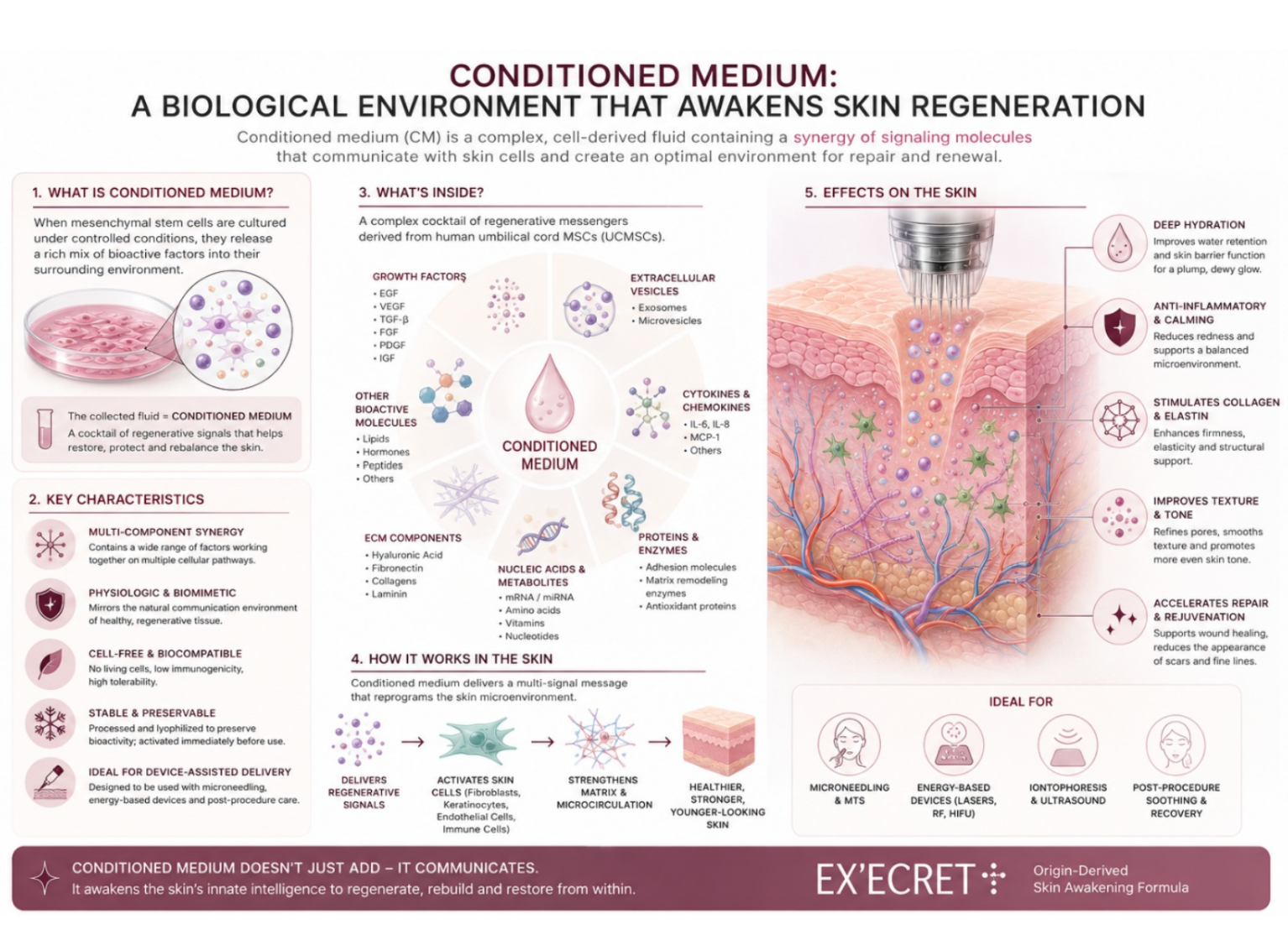
For me, this distinction is important. The evolution of regenerative aesthetics should not simply become a race to claim the highest concentration of exosomes. Biology rarely works through one isolated signal. Skin regeneration involves continuous communication between keratinocytes, fibroblasts, endothelial cells, immune populations, and the extracellular matrix.
The future may consequently belong not to one “hero ingredient”, but to intelligently designed combinations of biological signals.
Enter EX’ECRET Skin Booster
Due To Launch at IMCAS Paris 2027
This was what made me interested in testing EX’ECRET, a new professional skin booster developed by HansPharma and planned for launch around IMCAS Paris 2027.
I recently joined the EX’ECRET Founding Doctor Program, which gave me the opportunity not only to learn about the technology before its wider introduction, but also to experience the treatment personally over three sessions.
The formulation is based on human umbilical cord-derived mesenchymal stem cell conditioned media (UCMSC-CM). According to HansPharma’s technical dossier, the conditioned media contain multiple regenerative factors, including EGF, VEGF and TGF-β, alongside other components of the cellular secretome.
There is also an interesting manufacturing story behind it.
HansPharma uses a proprietary 3D bioreactor culture system, rather than conventional flat 2D cell culture. The company reports that its process is designed to generate and recover regenerative factors, including growth factors and exosomes, within a more physiologically relevant three-dimensional culture environment.
The conditioned media are then purified and freeze-dried. The product is supplied using a two-component “Dual Key” system: a lyophilised powder — the Origin Key — and a liquid activator — the Awakening Key — which are combined immediately before the procedure. The intention is to protect unstable biological components during storage and reconstitute them shortly before application.
From a practical clinical perspective, I find this approach particularly interesting.
Why Pair Regenerative Signals with Devices?
A sophisticated topical formulation is of limited value if it simply sits on top of an intact stratum corneum.
EX’ECRET has therefore been developed specifically around device-assisted delivery and post-procedure application. Its proposed professional protocols include microneedling/MTS, skin stamping, iontophoresis and ultrasound-assisted application, as well as application following energy-based treatments such as fractional and pigment-targeting lasers.
This makes considerable sense conceptually.
Microneedling and energy-based devices create a controlled tissue response. The skin temporarily enters a state characterised by increased cellular signalling, inflammation, repair and extracellular matrix remodelling. At the same time, some procedures temporarily increase cutaneous permeability.
The treatment philosophy therefore becomes fascinating: create a controlled regenerative stimulus and then optimise the environment in which recovery occurs.
It is less about forcing the skin to change and more about supporting what the skin is already attempting to do.
Dr. Alberto Leguina-Ruzzi Review of EX’ECRET Skin Booster from HansPharma
So, What Happened to My Skin?
Of course, reading a technical dossier is one thing.
Having the procedure performed on your own face is quite another.
Over the course of the EX’ECRET Founding Program, I underwent three treatment sessions. I approached the experience with the same curiosity — and healthy scepticism — that I apply whenever evaluating a new aesthetic technology.
What interested me most was that I did not perceive one dramatic isolated change. Instead, I noticed improvement across several parameters that collectively determine what we rather loosely call “skin quality.”
My skin appeared better hydrated and progressively smoother. Fine lines became less noticeable, and the overall texture looked more homogeneous. I also observed improvement in residual acne-scar irregularities and, particularly interestingly for me, a reduction in background erythema.
The cumulative effect was not a different face. It was simply better-looking skin.
And personally, that is exactly what I want from regenerative aesthetic medicine.
No artificial volume. No alteration of facial proportions. No obvious sign that something has been “done.”
Just healthier-looking, calmer, and more refined skin.
It is important, however, to put those observations into perspective. This was my personal experience after three sessions, not a controlled clinical trial. Improvements that I perceived in hydration, wrinkles, erythema, scars, and texture should therefore not be interpreted as proof of efficacy for those individual indications.
That distinction matters enormously as regenerative medicine becomes increasingly fashionable.

The Science Is Interesting — But So Is the Safety Question
Whenever we discuss stem cell-derived products, exosomes or conditioned media, enthusiasm should always be accompanied by questions about manufacturing, purity, stability and biocompatibility.
HansPharma’s development programme includes in-vitro experiments using senescent human dermal fibroblast models, scratch-assay experiments evaluating cell migration, and aged-animal wound-recovery models. Its presented laboratory data also report changes in extracellular-matrix-associated markers including COL1A1 and fibronectin following exposure to EX’ECRET.
The scratch-assay experiments are particularly relevant to the regenerative concept: the company’s data show increased fibroblast migration and proliferation following exposure to UCMSC-conditioned media.
The dossier also reports a series of toxicological and biocompatibility assessments covering acute and repeated-dose dermal toxicity, genotoxicity, phototoxicity, sensitisation, ocular irritation and skin irritation, including testing in a reconstructed human skin model and human subjects.
These are encouraging foundations, although they should not be confused with large-scale, peer-reviewed clinical evidence. As with many emerging regenerative technologies, the next important step will be seeing robust clinical studies confirm which indications benefit most, how long improvements persist, and which combinations with devices provide the best risk-benefit profile.
Are We Entering the Post-Exosome Era?
Perhaps this is the question I found myself thinking about most after testing EX’ECRET.
Exosomes opened an important door in aesthetic medicine because they made practitioners think differently about cellular communication. But concentrating on exosomes alone may ultimately prove too simplistic.
Conditioned media introduce a broader concept: regeneration as a network rather than a molecule.
Growth factors, extracellular vesicles, proteins and signalling mediators do not operate independently in living tissue. They interact. And if regenerative aesthetics continues to mature, our treatments may increasingly attempt to reproduce these coordinated biological environments rather than delivering progressively higher concentrations of one fashionable ingredient.
EX’ECRET is an interesting example of this transition.
For me, its appeal is not simply that it contains stem-cell-conditioned media or exosomes. It is the combination of biological signalling, controlled manufacturing, preservation through lyophilisation, and integration with microneedling and energy-based procedures that makes the concept worth watching.
After three sessions, my personal experience has certainly made me curious to continue exploring it.
Will conditioned media become the next major category in regenerative aesthetics?
We still need considerably more independent clinical evidence before answering that question.
But judging from the direction in which the science — and my own skin — are moving, IMCAS Paris 2027 may be a very interesting place to continue the conversation.